How Publishers Use Subtitle Archives to Scale Short-Form Video Production
Turn subtitle archives into stronger short-form videos. Find quotes, shortlist clips, build vertical previews, and measure time saved, CTR, and completion.
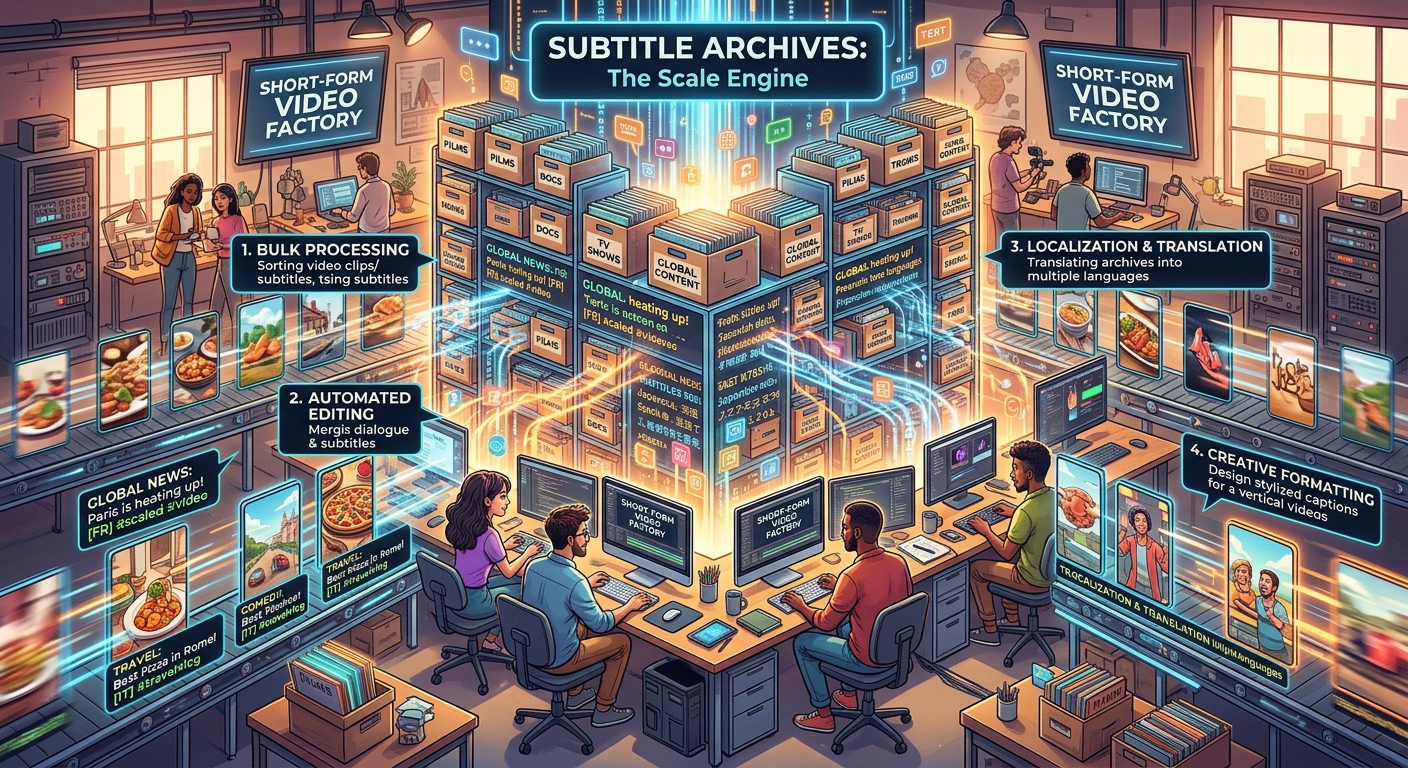
The quote your video team needs may already be sitting inside a two-hour interview. Finding it is the expensive part. An editor scrubs through footage, checks a transcript, opens another recording, and repeats the process. Meanwhile, a publishing window gets smaller. Subtitle archives give publishers a searchable starting point, helping teams locate promising moments before they spend time cutting footage.
From Archive to Editorial Shortlist: Treat subtitle files as an index into your video library. Search for relevant statements, save candidate timestamps, and review the corresponding footage before building vertical previews. Keep rights information and source references attached throughout production. Measure whether this process reduces editorial handling time, then test whether the finished previews earn more video starts and hold attention through the final frame. Faster retrieval helps only when the published result remains accurate and engaging.
Start With the Editorial Question Behind the Clip
A subtitle archive becomes useful when someone brings a clear editorial question to it. “Find something about housing” creates a large pile of results. “Find a speaker explaining why first-time buyers are delaying purchases” gives an editor a sharper target.
Build the search around an audience need, a current story, or a recurring programming theme. A news team might need a concise explanation of a policy change. A sports desk might want a coach describing a turning point. An entertainment publisher might need a revealing answer from an earlier interview.
Search for concepts as well as exact wording. A speaker discussing ticket prices may say “admission costs” or “what fans pay.” Names can appear with spelling variations. Automatic captions may mishear specialist terms. Search expansion can help surface candidates, but a matching phrase is only a lead.
The editorial question should stay attached to the shortlist. It gives the reviewing editor a reason to choose one moment over another. It also prevents a familiar problem: publishing a lively quote that has little connection to the story readers came to see.
Make Subtitle Records Traceable to Their Source Videos
A folder full of subtitle files is a starting point. A usable archive needs a dependable connection between each file and its original video. Without that connection, editors can find a sentence and still lose time locating the footage.
Keep a stable asset identifier with every subtitle record. Preserve the original timing data, language, and video version. A subtitle file created for a shortened broadcast may not align with the full interview stored elsewhere.
At minimum, each searchable record should carry these details:
- Source identity: Asset ID, programme or event name, recording date, and a working reference to the video.
- Subtitle details: Language, file format, version, and whether the text has received human correction.
- Usage permissions: Ownership or licence status, permitted channels, territory limits, and expiry dates where relevant.
- Editorial context: Topic labels and verified speaker information when available.
Keep the original subtitle file intact. If your search system creates a cleaned text version, retain a mapping back to the original cues. Editors need readable search results, but they also need timestamps they can verify.
Turn Search Matches Into a Reviewable Clip Shortlist
A useful result shows more than a highlighted sentence. Include nearby subtitle cues, the candidate time range, and the source identifier. Context helps an editor judge whether the speaker is making a claim, quoting someone else, or answering a question that changes the meaning.
Rank candidates by editorial usefulness. Does the statement make sense without a long introduction? Does it contain a clear idea? Can the audience understand who is speaking and why the statement matters?
AI-assisted search can help group related passages or suggest possible excerpts. Treat those suggestions as retrieval assistance. Any proposed quotation must be checked against the recording, including wording that a subtitle file may have transcribed incorrectly.
Use a consistent sequence to move from search results to approved candidates:
- Define the audience question and intended destination for the video.
- Search relevant terms, alternative phrases, names, and topic labels.
- Save promising passages with surrounding context and source timestamps.
- Watch each candidate in the original recording and check its meaning.
- Select excerpts with clear speech, usable pictures, and suitable permissions.
- Send the approved shortlist into editing with a short explanation of each choice.
A shortlist of five strong candidates can be more useful than fifty loose matches. The aim is to reduce review work while preserving enough choice for editorial judgment.
Collect Available Files Without Losing Their Provenance
Once the team has defined its archive structure and review process, it can collect available subtitle files from owned or licensed videos. A bulk subtitle downloader can support that collection step where subtitle access and the intended use are permitted. Keep the resulting files connected to the correct asset records as they enter the archive.
Collection does not establish publication rights. A publisher may have permission to host a full programme but need separate clearance for promotional excerpts or distribution on another channel. Record those conditions before a candidate reaches the editing queue.
Check a sample of each incoming batch. Confirm that files open correctly, use the expected language, and correspond to the intended video versions. Look for missing passages and inconsistent timing. Catching those issues during intake prevents repeated troubleshooting across multiple edits.
For multilingual libraries, preserve separate language tracks. Translations can support search and adaptation, but editors should verify sensitive wording against the original speech with appropriate language support.
Check Timestamps Against the Actual Recording
Subtitle timestamps are navigation aids. They are rarely sufficient as final edit boundaries. A cue may begin after the first spoken sound or end before a speaker completes a thought. Several cues may divide one sentence.
Open the source video before and after the proposed excerpt. Listen to the complete answer. Check whether the speaker adds a qualification just outside the selected range. Watch for edits that would reverse the meaning or make a conditional statement sound certain.
Confirm timing against the exact file used for production. An inserted introduction, a removed break, or a different export can shift every candidate timestamp. If the offsets differ, resolve the version mismatch before creating multiple clips.
Choose boundaries by listening and watching. Leave enough room for natural speech and a clean ending. A technically accurate quote can still feel abrupt if it starts halfway through a breath or ends before the audience understands the point.
Build Vertical Previews Around a Complete Thought
Short-form production needs visual decisions that subtitle search cannot make. A strong sentence may accompany an unusable camera angle, a crowded graphic, or a demonstration that disappears inside a vertical crop.
Build the preview around one complete thought. Give viewers enough context to understand the speaker and the subject. If the opening needs a short text label, make it specific and faithful to the footage.
Review the vertical composition throughout the excerpt. Keep faces and relevant action visible. Check captions and labels against interface overlays for the intended destination. Reframe individual shots when a single crop cannot preserve the information viewers need.
Preview captions deserve their own review. Shorten line lengths for a narrow screen, check names and numbers, and match the text to the final audio. If the edit changes, check caption timing again.
Before publication, the reviewing editor should confirm:
- The excerpt preserves the speaker’s meaning and relevant context.
- The opening text and preview promise match what the video delivers.
- The crop, captions, graphics, and audio remain understandable throughout.
- Permissions cover the planned channel, territory, and publication date.
- The final export matches the approved edit and caption version.
Measure Editorial Time Saved Across the Whole Workflow
Measure the archive workflow against a clear baseline. Track active editorial minutes spent finding candidates, reviewing footage, preparing previews, and completing corrections. Separate active work from time spent waiting for approval or rendering.
Compare similar assignments. A straightforward interview excerpt should not be measured against a complex sports package with several rights checks. Include archive maintenance and unsuccessful searches when assessing the broader operating cost.
For an illustrative calculation, imagine comparable previews previously required 50 active minutes each. The archive workflow reduces that to 35 minutes. That represents 15 minutes saved per preview, or a 30% reduction. Across 40 previews, the gross saving would be 10 hours before shared archive upkeep is deducted.
These figures are a worked example, not a performance forecast. Your own results should show whether saved time comes from retrieval, editing, or fewer handoffs. Track correction rates alongside speed to check whether faster production creates extra review work later.
Connect Preview Performance to CTR and Completion
Production efficiency and audience response answer different questions. Editorial time saved tells you whether the workflow is cheaper to operate. Video click-through rate tells you whether the preview earns a click within a defined placement.
Define CTR consistently. For a publisher-controlled placement, you might calculate video clicks divided by eligible preview impressions, multiplied by 100. Use the same eligibility rules across variants. Keep autoplay starts separate from deliberate clicks.
Measure completion using a documented definition, such as completed plays divided by video starts. Compare clips of similar duration and account for differences in placement, audience, and traffic source. A shorter clip can have a completion advantage simply because it asks for less viewing time.
Test one meaningful change at a time where possible. Compare two openings for the same approved excerpt, or two preview treatments in the same placement. Set the evaluation window and sample requirements before interpreting results.
Read CTR and completion together. Higher CTR with lower completion may suggest the opening promises more than the clip delivers, though audience differences can also explain the pattern. Higher completion with low CTR may point toward a weak preview. Use the figures to guide a review of the actual creative.
Give Every Strong Quote a Shorter Path to Publication
A subtitle archive earns its place in production when it helps editors find worthwhile moments with less searching. Begin with a defined collection, reliable source records, and a repeatable review process. Expand once the team can trace each candidate from search result to approved export.
The strongest workflow joins searchable speech with visual judgment. Editors find the relevant passage, verify its context, shape a clear vertical preview, and measure the result. That gives publishers a practical way to produce more from their existing footage while keeping editorial decisions close to the work.