How Publishers Turn Video Libraries Into Durable Search Traffic
Most publishers can't get crawlers to index their raw video. Here's the AI-assisted workflow that fixes it and ties directly to dwell time and CPM gains.
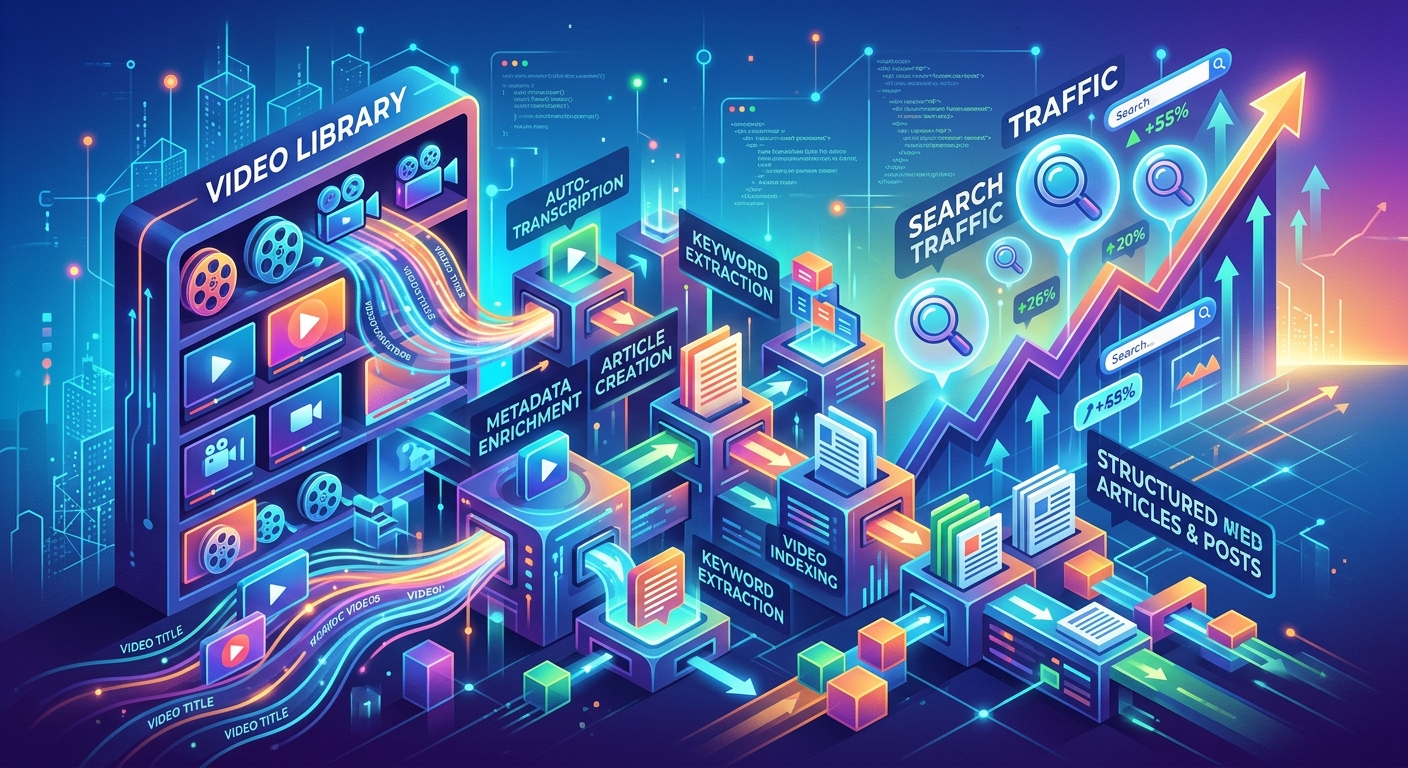
Your video library is probably one of the most expensive assets your editorial team has ever built. Hours of footage, years of production effort, tens of thousands of dollars in licensing and crew costs. And Google can read almost none of it. Search crawlers index text. They index structured data. They index captions and transcripts when those exist. But the raw MP4 sitting on your CDN? For most publishers, it might as well be invisible. That gap between what you've produced and what search can actually find is costing real, measurable traffic every single month.
The Case for Text-First Video Strategy
Search engines still cannot parse raw video files. Publishers who address this through AI-driven peak extraction and structured text conversion earn compounding organic visibility from content they have already paid to produce. The workflow is not complex, but it demands one deliberate text extraction step most editorial teams skip entirely. Those who build it into their process consistently see stronger dwell time figures and measurable CPM lift as a direct result.
The Crawl Gap Most Editorial Teams Never Think About
Most video strategy conversations focus on distribution and click-through rates. Rarely does anyone ask whether the video content is searchable in the first place. For most organizations, the honest answer is no.
Google can index video content when specific conditions are met. There must be a dedicated landing page for the video. That page needs structured data markup, typically VideoObject schema. A transcript or caption file dramatically improves the crawler's ability to understand context and relevance. Without those elements, even a compelling, high-production clip sits in a search blind spot.
According to Google's video indexing guidelines, providing a transcript or description "helps Google understand what your video is about." That is not a minor technical detail. It is the difference between a content asset that compounds in value over time and one that only earns views during the week it is published.
The publishers who have figured this out are not doing anything exotic. They have simply added one structured workflow step between production and publication. The result is that their video content ranks, surfaces in featured snippets, and pulls organic traffic for months after the original post date.
Why AI Peak Identification Comes Before Anything Else
Not every frame of your video archive deserves a dedicated search landing page. That would be neither realistic nor desirable for a team managing hundreds of clips across multiple topics. The smarter approach starts with identifying which moments inside your existing library carry the most informational density.
AI-assisted peak identification does exactly that. It analyzes engagement signals, audio intensity, semantic content, and visual cut patterns to surface the segments worth treating as standalone content objects. Those might be a 90-second product explanation buried inside a 45-minute interview. Or a three-minute tactical breakdown embedded in a full-match replay. Or a policy statement from a 20-minute press conference that carries the actual news value.
Once you know where the value lives, the text extraction step becomes targeted rather than sprawling. You are not transcribing everything. You are transcribing what matters, which is a fundamentally different and far more scalable task.
This is where most editorial workflows fall apart. Teams try to manually caption everything, or they add closed captions purely for accessibility compliance and stop there. Neither approach treats the resulting text as a search asset. The goal is a repeatable pipeline from peak moment to indexed page, not a one-off captioning project.
The Text Extraction Step That Changes Everything
Once high-value clips are identified, turning them into indexed content requires one process most teams have never formally built: generating accurate, structured text output from the video itself.
Running those clips through a video to text pipeline produces several assets from a single pass. You get time-coded captions that embed directly on the page. You get a raw transcript that forms the backbone of an article companion. You get keyword-rich metadata that feeds into your VideoObject schema. And you get the source material for summary text eligible to appear in Google's rich result formats for video content.
These are not separate tasks requiring separate tools. They come from one extraction pass per clip. The editorial team then edits for accuracy, adds human context, and shapes the output into a publishable page. The machine handles the time-consuming transcription work. Editors make it accurate, readable, and genuinely useful to the audience.
What a Text-First Video Page Actually Contains
A properly structured video landing page is not just an embed with a title slapped above it. It carries several distinct text layers that help both crawlers and readers understand exactly what they are getting:
- A headline and meta description drawn from the clip's actual spoken content, not marketing copy written at publication time
- A full-length transcript formatted for readability, with speaker labels and natural paragraph breaks
- Time-coded chapter markers that let readers jump directly to the moments most relevant to their query
- VideoObject schema populated with accurate duration, thumbnail URL, upload date, and a content-specific description
- A short article companion that synthesizes the clip's key points in prose form, targeting the queries a video title alone would never capture
Each of these elements is something a crawler can read, process, and use to determine relevance. Together they turn a single video clip into a content object capable of ranking, earning backlinks, and returning organic traffic long after the original publication date.
Article Companions as a Second Traffic Channel From the Same Clip
The article companion deserves particular attention. This is the piece of content, typically 400 to 700 words, that lives on the same page as the video or directly beneath the embed. It covers the same ground as the clip but in prose form.
This is not duplicate content in the problematic sense. The article companion provides genuine reading value for users who prefer text, and it provides indexable depth for crawlers that cannot process an audio track. When written well, the article companion functions as a standalone piece. It earns internal links. It targets long-tail queries that a video headline would never surface for.
Editorial teams that consistently produce article companions alongside their clips effectively build two content channels from the same production effort. The video earns discovery through social distribution and direct promotion. The article companion earns discovery through organic search. The combined page captures both audiences and benefits from the engagement signals each generates.
The Measurable Link Between Indexed Video and Revenue Performance
The organic search argument for text-indexed video is compelling on its own. But publishers at the monetization stage care about a more direct outcome: what does this workflow actually do for CPM and ad revenue?
The connection runs through dwell time. When a visitor lands on a page containing both a video embed and a text companion, session duration increases. Readers move between formats. They watch part of the clip, read a section, watch more. That behavior signals content quality to both ad servers and search algorithms, and the signal carries real commercial weight.
Higher dwell time improves viewable impression counts. More viewable impressions drive better CPM performance on programmatic inventory. The video itself unlocks pre-roll and mid-roll ad opportunities that simply do not exist when the clip is buried in an archive with no dedicated page.
Indexed vs. Non-Indexed Video Pages: What the Metrics Look Like
| Performance Dimension | Non-Indexed Video Page | Text-Indexed Video Page |
|---|---|---|
| Organic search visibility | Minimal to none | Eligible for standard and rich results |
| Average dwell time | Lower; video-only engagement | Higher; multi-format reading behavior |
| Long-tail keyword reach | Near zero | Broad; driven by transcript vocabulary |
| Ad inventory depth | Social and direct traffic only | Programmatic, search, and direct |
| Content lifespan | Days to weeks | Months to years; compounds over time |
Where the Performance Gains Accumulate
Publishers who have shifted to structured, text-accompanied video pages report improvements across a consistent set of KPIs. These gains are not speculative or theoretical:
- Pages with video transcripts hold users 30 to 40 percent longer than video-only pages across multiple publisher benchmarks, improving both session depth and return visit rates
- Video pages with VideoObject schema earn higher organic click-through rates because thumbnail previews appear directly in search results, making the listing visually distinct
- Article companions consistently surface for long-tail queries that would never appear in a video title or tag, adding a secondary discovery layer with no additional production cost
- Programmatic CPMs improve as session-level engagement signals strengthen the quality score attached to the page in real-time bidding environments
These outcomes build on each other over time. A text-indexed video page that earns a stable search ranking keeps generating traffic months and years after publication. A social-only video drop earns traffic for days, then fades entirely.
Your Archive Is Already Sitting on Untapped Search Value
Most publishers already own more search-eligible content than they realize. It is sitting in their video archive, unindexed and unattributed, because no one has built the workflow to connect production output to organic visibility.
The workflow itself is not out of reach. AI handles peak identification at scale. A text extraction pipeline handles transcription without requiring manual effort on every clip. Editors shape the output into a structured, publishable page. Schema markup makes that page eligible for rich results in search. The article companion gives the page keyword depth. None of these steps require tools or skills that a modern publishing team does not already have access to.
The publishers who will hold durable search positions over the next few years are treating their video library not as a broadcast archive but as a content database. Each clip is a potential ranking page. Each transcript is potential featured snippet material. Each article companion is a long-tail traffic driver waiting to be indexed.
The crawl gap is real, and it is costing publishers measurable revenue today. Closing it starts with one deliberate workflow change. The traffic gains that follow are not a bonus. They are the return on production investment that should have been there from the beginning.